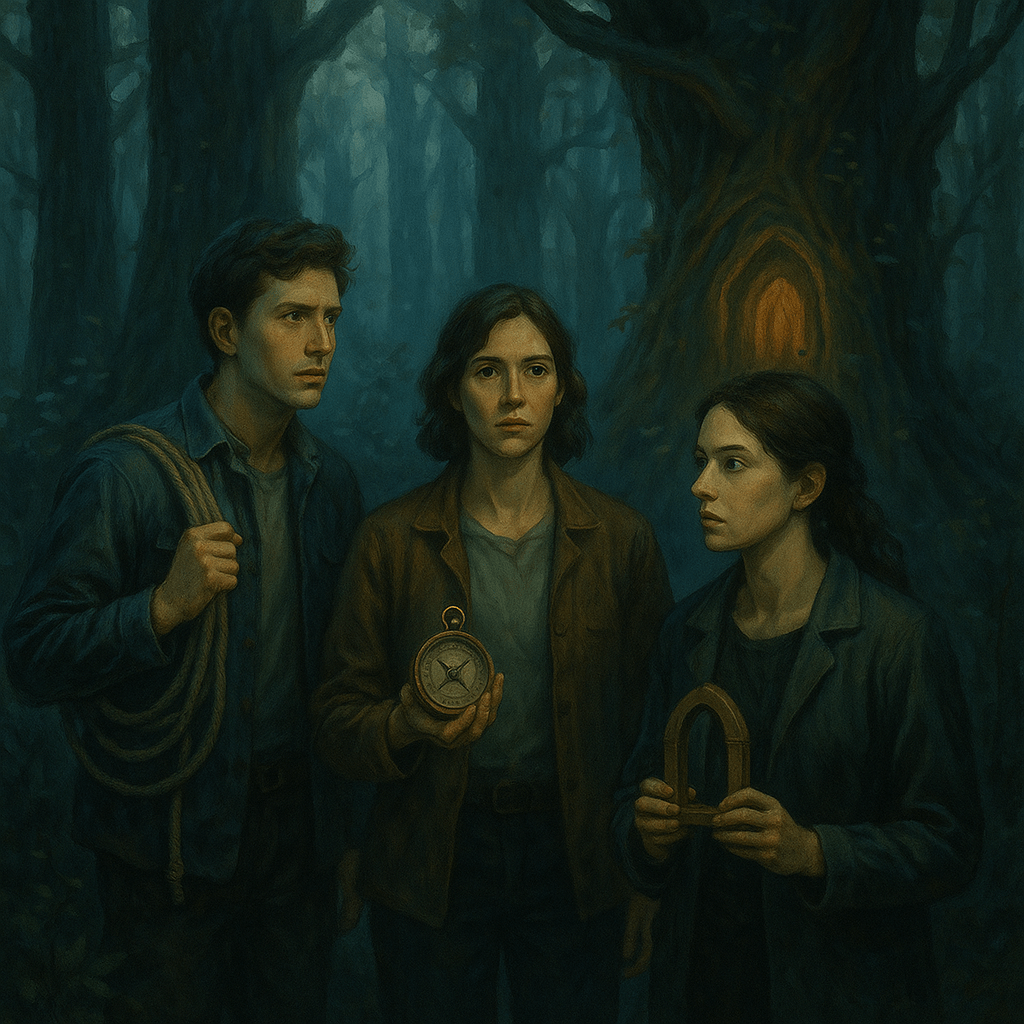
The Thirteenth Path
Prologue: The Map Without North
At dusk, when the air held the smell of rain and iron, a forest older than any village breathed fog across its roots. Travelers called it the Verdance, but the people who lived closest to it refused to call it anything at all. If pressed, they said only: the paths move at night.
A paper map—hand-drawn in sepia ink—lay pinned to a fallen trunk near the boundary stones. It had no compass. Along its edges someone had penciled a single instruction: Choose the thirteenth path. Tell the truth.
The map waited. And then three strangers arrived from three different roads, each believing they had come alone.
Chapter 1: Mara, Who Counted Losses
Mara kept lists to stop herself from floating away. Things I Lost. Things I Found. Things I Should Have Said. She had driven until the fuel light blinked orange, the road curling toward a dark seam of trees. Her fingertips still smelled faintly of hospital soap. The habit lingered long after the reason was gone.
She saw the map first and didn’t trust it. No one left directions in the wild without wanting something in return. And yet the paper tugged at her with that old, quiet ache—the one that asks if there’s still a door to a life where a different choice was made.
Footsteps crackled behind her. She turned. A tall man in a threadbare navy peacoat stopped at the boundary stones, as if unsure whether to bow.
“I thought I was alone,” he said.
“You weren’t,” Mara replied.
He stepped closer, eyes the color of rainwater. “No compass,” he said, nodding at the map. “That’s a bad joke.”
“Or a warning,” she said.
A shadow detached itself from a spruce trunk—a slight woman with a backpack and an expression like a drawn arrow. “The thirteenth path,” the woman read, crouching to study the paper. “If there are only twelve, we’re in trouble.”
“Maybe you’re on the wrong side of the trunk,” said the man.
“Or maybe the paths move at night,” Mara said before she could stop herself. She didn’t ask how she knew that. She didn’t want to know.
The three of them counted the visible tracks: narrow cuts in the fern, corridors between roots, ribbons of pale dirt. Twelve. And then as the sun slid under the horizon and dusk became a single, held breath, a new ribbon of earth opened where there had been nothing, edged in moss that glittered as if threaded with frost.
“Thirteen,” said the man, sounding both pleased and afraid.
No one suggested not going in. They adjusted their packs that didn’t weigh what they remembered packing; they watched the new path breathe. And then they stepped onto it together, because going in as three felt safer than going in as one.
“I’m Jonah,” said the man.
“Lena,” said the slight woman, then bit the inside of her cheek. “No. Sorry. Not Lena. I’m Eve.”
“Mara,” said Mara, relieved to find one name still obeyed her.
The Verdance accepted them without fuss. The thirteenth path turned left where it should have turned right, and went uphill by going downhill.
Behind them, the entrance closed like a tide.
Chapter 2: Jonah, Who Heard the Dead Speak Plainly
Jonah had come because the letter told him to. The letter arrived in the hand he had not seen since the funeral: his brother’s crooked, impatient script. Tell the truth, the letter said. And bring rope. He had brought the rope. He wasn’t yet ready to take inventory of what else he carried.
The forest did not smell like any forest he knew. Spice. Old coins. Something like a storm wrapped in honeysuckle. Mushrooms grew in constellations. Leaves held a glaze of silver. The path forked, then un-forked, then forked again as if changing its mind.
Eve kept pace with the path like a negotiator walking a difficult client. She wore a thin braided band around her wrist with a wooden charm carved into a key. Every time the path shifted, her thumb brushed the charm. It seemed less like a habit than a code.
Mara walked as if she were conserving herself, choosing the exact stones that would not scrape. In the green hush her breath sounded like paper turning.
They found the first marker just before full dark: a tiny bell strung from a branch with thread. It rang though no wind stirred.
Mara reached up before Jonah could warn her. The bell’s note shivered the ground; words slid across the path like fish in a stream. Tell the truth.
“What truth?” said Eve, voice flat.
The bell rang once more and went still.
Jonah opened his mouth and the lie he planned—this is ridiculous, it’s a trick—evaporated. Instead he said, “I’m here because my brother asked for rope. He’s dead.”
Eve’s mouth twitched. “I’m here because I lost a key I never owned.”
Mara closed her eyes. “I’m here because I didn’t say goodbye.”
The bell was still. The path nodded—Jonah couldn’t explain how he knew that, but he did—and allowed them on.
They walked until the dark turned liquid, until the sky vanished like a page torn clean from a book. When they stopped, it was because a door waited in the path where there should have been none: a freestanding door, unconnected to any wall, weathered blue, a brass nameplate polished by invisible hands.
The nameplate read: Archivist.
“Absolutely not,” said Eve, which usually meant absolutely yes in stories like this, Jonah knew. He surprised himself by smiling.
Mara’s hand hovered over the knob as if it might bite. The door smelled faintly of smoke and lavender. She turned the knob. The door opened without a hinge’s complaint.
Inside was a room the size of a church and the size of a cupboard and the size of a thought: shelves spiraled upward, crammed with objects labeled in script that crawled as you watched it. Bones, marbles, a child’s red shoe, eight identical compasses each pointing in a different direction, a postcard of a place with two suns.
Behind a desk stacked with ledgers, a person in a gray coat looked up. They were old and young in alternating blinks, their hair like a cut shadow.
“You’re late,” said the Archivist, not looking at a clock. “But the forest is patient when it wants something.” They pointed at three stools that arrived under the travelers as if conjured by embarrassment. “State your losses.”
“We already told the bell,” Eve said.
“The bell is a receptionist,” said the Archivist. “I’m Accounts.”
Jonah cleared his throat. “We’re looking for—what are we looking for?”
“North,” said Mara. “We’re looking for North.”
The Archivist smiled. “A popular request. We keep it on the top shelf.” They tapped the ledger. “Truth in exchange for passage. Three truths per person. Different from admissions at the threshold; we take those at face value.”
Eve’s jaw tightened. “And if we refuse?”
“You wander until wandering becomes the only verb you own,” the Archivist said, sympathetic. “After that, we file you under Fog.”
Mara’s three truths arrived like stones she had carried long enough to think they were part of her. She spoke them quietly and did not look at the other two. The Archivist added each to the ledger with neat, hungry pen strokes.
Eve’s truths were not what Jonah expected. None were, of course; that’s why they were truths. But when she said the name she had denied at the forest’s edge—Lena—Jonah felt the path crease outside the door, as if a muscle spasmed.
“My turn,” Jonah said, before the room could weigh the name further. He thought of his brother—the river, the rope left coiled on the dock, the note that did not ask for help so much as order it—and felt his chest salt itself from the inside. “I told him not to jump,” Jonah said. “I told him I’d fix it. That was the first lie. The second is that I have forgiven him. The third is that I don’t want to follow him.”
The Archivist’s pen slowed. “You don’t?”
Jonah swallowed. “I don’t know.”
“Acceptable,” said the Archivist, voice not unkind. They shut the ledger. “Two roads are paid for, and one is mortgaged.”
“Which?” Mara asked.
The Archivist nodded to the shelves. “Find your objects. They’ll know you.” And then, like a teacher who has allowed enough questions, they faded without moving.
The shelves hummed. Eve reached without looking and pulled down a brass key that might have fit a lock two centuries asleep. It fit her palm too well.
Mara found a glass phial corked with wax. Inside was a smell; when she unstoppered it just enough to taste the air, she almost dropped to her knees. Summer wheat. Antiseptic. A sleeping room with no machines.
Jonah passed his hand over a dozen compasses and felt nothing. The rope he had brought coiled heavier on his shoulder. Then, on a low shelf near the floor, he saw the thing he had not wanted: a small stone with a crack shaped like a river delta. Warmth bled from it into his skin when he lifted it.
“North,” said Eve, pointing. Above the desk, a ladder had grown from nowhere to the top shelf. On it sat a wooden box bound with twine. Stenciled on the side in fading paint: NORTH (Borrowed Often; Rarely Returned).
They did not ask permission. When Mara untied the twine, the box unfolded to reveal a compass without markings. It did not point. It listened.
“How does it work?” Jonah asked.
“Not to where,” Mara whispered. “To whom.”
The needle turned until it steadied between them, not pointing outward but circling their triangle—Mara, Eve, Jonah—and then stopping, quivering, at the empty space in the middle.
“Great,” Eve said. “Our north is a hole.”
“Or an absence,” Mara said.
Jonah looked at the stone in his hand. The crack matched the compass’s center perfectly. He placed the stone in the gap. The needle lunged as if pulling breath for the first time, then settled toward a door on the far side of the room. Not the blue door they had entered, but a door made of woven branches, green and living.
“Accounts is closed,” said the Archivist’s voice from somewhere in the stacks. “Please leave an honest review in the logbook on your way out.”
The living door opened. The forest took them back.
Chapter 3: Eve, Who Was Two People and One Wound
She had taken the name Eve because it was a beginning. Before that she had been Lena to the person she loved most and feared most—herself reflected in someone else’s eyes. Beginnings can be escape routes if you run fast enough; they can also be circles if you don’t.
The thirteenth path smoothed under their feet as if pleased with their errand. The needle held steady, pulling them toward a low valley where mist fountained up from the ground. Silhouettes of standing stones broke the horizon like knuckles.
“Does the forest end?” Mara asked, not to any person.
“Yes,” said a voice none of them recognized. It came from the mist. “But ending is a kind of trick.”
A figure emerged: a woman with hair braided in a crown, eyes fog-pale. She wore a cloak the exact color of wet bark. Around her neck hung a ring of small bells.
“I’m the Warden of Little Truths,” she said, as if that were a job one could apply for. “I tend the stones. They complain if unattended.”
“What do they complain about?” Jonah asked.
“Being stones,” said the Warden. “Wouldn’t you?” She looked at the compass. “Ah. Borrowed property. That means you have a question you are trying not to ask.”
Eve’s thumb worried the key charm. “We’re following an absence,” she said.
“Then you’ll need a presence to make the outline of it,” said the Warden. “That’s how negatives work.” She pointed to the ring of stones. “One of you is missing a person. One of you lost something you never owned. One of you refuses to choose shore or water.” She smiled. “Step into the circle.”
“Why?” Jonah said.
“So the forest can hear you,” said the Warden. “It’s hard of hearing when you mumble.”
They stood inside the ring. The mist tasted like cold metal on Mara’s tongue. The Warden’s bells made no sound, but the air trembled anyway.
“Who are you missing?” the Warden asked Mara.
Mara pressed the phial to her lips and tasted summer again, the antiseptic cut by sunlight. “My daughter,” she said, and the truth fell cleanly for once. “I spoke to the machines instead of to her. When the last night came, I believed there would be one more.”
The stones thrummed. The mist shook. Jonah felt the rope on his shoulder tug, once, as if someone pulled from the other end.
Eve closed her eyes. “I stole a key,” she said. “Not with my hands. With a promise. I said I’d stay. I didn’t. The door locked after me. The person on the other side learned to live without the door. I kept the key.”
“Return it,” the Warden said, gently. “Or accept that it belongs to you because of what it unlocked.”
Jonah’s throat hurt. He wanted to be angry that this place, green and strange, knew the shape of his grief. But anger and grief were twins; he had spent so long trying to tell them apart.
The Warden tilted her head at him. “Shore or water?”
He lifted the stone with the river crack. “I thought if I stood on the dock long enough, the river would tire of asking.” His voice sounded older. “It didn’t. He jumped anyway.”
“And what does the river want now?” the Warden asked.
“For me to stop pretending I can fix both banks.” He looked at the compass. The needle trembled toward a narrow cleft between two larger stones, a sluice of fog. “It wants me to choose.”
The Warden nodded, satisfied the way gardeners are when a stubborn plant finally buds. “Go on, then.”
Eve hesitated. “If we step through, what do we leave behind?”
“Whatever you try to carry with your teeth,” said the Warden. “Go with your hands open.”
They went. The cleft was a throat, the fog a breath. On the other side the forest opened into a hollow lit from beneath, as if the earth glowed with banked coals. In the hollow stood a tree whose bark moved like slow water. From its branches hung dozens of objects on strings—locks, phials, stones, tiny bells, and, on the lowest branch, a wooden door no taller than a child.
“It’s a memory tree,” Mara whispered.
“Close,” said a voice. It took them a moment to see that the tree itself had spoken. “I’m the Ledger. The Archivist outsources special accounts to me.”
Eve laughed then—a small, exhausted, relieved sound. “Of course you are.”
The Ledger’s leaves shivered. “You’ve brought me North. Excellent. Most people lose it on the way.”
“We haven’t had it long,” Jonah said.
“That’s how you keep things,” said the Ledger. “Long enough to return them.”
“Return?” Mara said, protective suddenly, hand on the compass.
“Yes,” said the Ledger. “But not before use. Each of you has a door to unlock. The forest doesn’t hand out tools for their shine.” A branch lowered three objects that had not been there a breath ago: a phial identical to Mara’s, but full and warm; a key split along its shaft so it could fit two locks at once; and a length of river-worn rope tied into a loop that could cinch or release with equal grace.
“One door leads forward,” said the Ledger. “One leads back. One leads sideways.”
“Which is which?” Eve asked.
The Ledger’s leaves sounded like pages turning. “Truth has three tenses. The forest prefers you choose your grammar.”
Mara reached for the full phial and felt, for the first time in months, the sensation of pressing her lips to a sleeping forehead. She did not cry. The tears had done their work already, carving her inward geography.
“I’m ready,” she said.
“Not alone,” Jonah said quickly.
“No,” Mara said, and took their hands.
The compass needle spun until it became a blurred coin. Then it clicked toward the tiny wooden door hanging from the low branch. The split key glinted in Eve’s palm. She slid one half into the door’s lock and kept the other half for whatever else waited. The door swung inward on silent hinges.
On the other side was a hospital corridor washed in night blue, machines blinking in cadence, and air that remembered a different season. The corridor belonged to a night that had already happened. But now it was here, threaded into a branch.
Mara did not let go of their hands. They stepped through together.
Chapter 4: The Corridor That Wasn’t a Corridor
Hospitals at night are a species of forest. That was the first thought Jonah had, and it steadied him. Branches of light. Machine breath. Paths that double back.
The room waited at the end of the hall. A girl slept inside—a child with dark hair and cheeks flushed the way the living flush. A woman sat in the chair beside the bed, her head lowered onto folded arms, exhausted into an angle of surrender.
“Mara,” Eve said, almost warning.
“I know,” Mara whispered. Her voice was a coin on a table, bright and hard. “It’s the night I went home to shower. The nurse said I should. She said the machines would keep watch.”
“Machines do watch,” Jonah said, not unkindly. “They don’t love.”
Mara stepped forward, but when she tried to touch her own shoulder—her other self’s shoulder—her fingers passed with a small fizz of static.
“You can’t change what happened,” Eve said softly. “That’s not what sideways doors are for.”
Mara stood at the bed. The child’s breath was a tide. The full phial warmed Mara’s palm. She unstoppered it and the room filled with the smell of a day they had missed: cut grass, bakery sugar, summer rain hitting hot stone. The child’s breath caught, then steadied. The woman in the chair smiled in her sleep, small and real.
“I didn’t say goodbye,” Mara said. “I can say hello.” She bent close. “Hello, love. I carried you through every room, even the ones this world doesn’t have names for yet.”
The monitors were not moved by poetry. But sometimes the heart is. Something eased; the child’s face softened into a moment of comfort she had not had the first time. It was not a cure. It was a blessing, retrofitted.
Mara corked the phial. The room dimmed to its original colors. “Forward,” she said.
They stepped back through the small door. The hollow and the Ledger of Leaves received them the way a book receives a bookmark at the end of a hard chapter.
“Two doors remain,” the Ledger said. Its branches rattled approvingly. “And a debt.”
“We’ll pay,” said Eve, before the forest could ask how.
Chapter 5: Rope and River
Jonah chooses between shore and water, Eve/Lena faces the person she left and what the split key truly opens, and the trio discovers why the map had no north in the first place—because North was meant to be made, not found.)
Want me to continue with Chapters 5–12 and bring the mystery to a full novel arc, or spin this into a series?
Chapter 5: Rope and River
Jonah had always thought rope was a tool for saving — throw it to someone, haul them back to safety, tie something down before it drifted away. But in the forest, the rope on his shoulder felt heavier than its weight, as though it remembered every use it had ever had, good or bad.
The Ledger’s branches bent low, leaves rustling in a voice just shy of words. “Two doors remain,” it reminded them. “One leads back. One leads forward. You choose.”
Jonah swallowed. “What happens if I choose wrong?”
The Ledger chuckled, a dry-paper sound. “Wrong is just another direction. But you’ll owe more than you already do.”
The compass needle twitched and steadied toward the far side of the hollow, where the earth sloped into a narrow ravine. Mist pooled there like water waiting for a signal to move. At its center, half-submerged in shimmering silt, was a dock — old planks, warped but somehow intact.
Jonah’s chest tightened. “This is it,” he said.
Eve looked at him sideways. “The river?”
He nodded, unable to speak. His hand brushed the rope coil, remembering the night his brother had stood on a dock just like this, rope dangling useless from Jonah’s grip because he had hesitated.
They descended. The mist thickened until the ravine felt like it was holding them instead of the other way around. The dock extended into the fog, vanishing after a dozen steps. Water lapped softly below, though Jonah couldn’t see its surface.
The Ledger’s voice echoed faintly behind them: “Truth has a price. Pay with choice.”
Jonah stepped forward. The rope uncoiled easily now, slithering from his shoulder as if eager for work.
Somewhere ahead in the mist, a shape took form — a figure standing on the far edge of the dock. He knew that stance. The set of the shoulders. The way the head tilted toward the unseen current.
“Evan,” Jonah breathed.
His brother turned, and the world narrowed to that moment — the same rainwater eyes, the same stubborn mouth. But there was no reproach in his expression this time. Only a quiet question.
“Are you here to pull me back,” Evan asked, “or to walk with me?”
Jonah’s breath caught. “I… I don’t know.”
“That’s the problem,” Evan said gently. “You’ve been standing between the two since the night I left. Rope in your hands, but no decision in your heart.”
Jonah’s fingers tightened on the coil. The mist shifted, showing two possibilities: in one, the rope bridged the gap between them; in the other, it slipped into the water and vanished, freeing his hands.
Eve’s voice came from behind, quiet but firm. “Choose, Jonah. The forest isn’t patient forever.”
He stared at the rope. At his brother. At the water, dark and waiting.
Jonah took a breath that felt like stepping off a ledge. He threw the rope — not to pull Evan back, but for Evan to catch if he wanted. It landed across his brother’s shoulders like a question mark.
Evan smiled, shaking his head. “Still you.” He let the rope fall into the water. “Then you walk forward without me.”
The mist closed around him.
Jonah reeled in the rope — lighter now — and turned back toward the others. His hands shook, but the tightness in his chest had loosened.
“Forward,” he said.
The compass needle spun once, then steadied toward the last door.
Chapter 6: The Split Key
The final door hung not from a branch, but from a vine-covered archway that hadn’t been there a moment before. The key in Eve’s palm glinted, its two halves joined but imperfectly fused, as if it had been broken and repaired with will alone.
“This is yours,” Mara said.
Eve didn’t answer right away. Her eyes were fixed on the door’s surface — carved wood, weathered smooth, with a single word etched into the grain: Home.
She slid the key into the lock. It turned with a sound like a sigh.
The door swung inward, revealing a dim apartment hallway lined with peeling wallpaper. The air smelled of old coffee and lavender detergent.
“This is—” Eve began, but stopped.
From a doorway halfway down the hall, a woman appeared. She had tired eyes but a steady stance, and she looked at Eve as if no time had passed.
“Lena,” she said.
Eve’s breath caught. “Don’t,” she whispered.
But the woman only tilted her head. “You still have it.” Her eyes flicked to the key. “I thought you’d throw it away.”
“I almost did,” Eve said. “But I… couldn’t.”
“Then you’re here for one reason,” the woman said. “Either return it, or use it.”
The air thickened. The hallway seemed to wait.
Eve stepped forward, holding out the key. Her hand shook. At the last moment, she pulled it back. “I can’t come back to what we had,” she said. “But I can unlock what comes next — if you’ll have it.”
The woman considered her for a long moment, then reached into her pocket and pulled out a small lock, old and tarnished. She held it out. “Then open this.”
Eve slid the key in. It turned without resistance. The lock fell open, and for an instant, the hallway smelled not of coffee and detergent but of wildflowers and open air.
The woman smiled — not the smile of forgiveness, but of understanding. “Then go,” she said. “You’ve got more forest to walk.”
Eve stepped back through the door, closing it gently behind her. The key was gone from her hand. In its place was a small wooden carving of the vine-covered archway.
Chapter 7: The Forest’s Debt
When they returned to the hollow, the Ledger was waiting. Its leaves were still, but its branches bent low in approval.
“You’ve paid in full,” it said. “North is yours to keep — if you wish it.”
The compass sat in Mara’s palm. Its needle pointed not outward, but to the space between the three of them.
“What happens if we keep it?” Mara asked.
“You’ll never be lost,” the Ledger said.
“And if we return it?” Jonah asked.
The Ledger’s branches rustled. “You’ll have to find each other again without it.”
They looked at one another.
Mara smiled faintly. “We’ll return it.”
Jonah nodded. “If we get lost, we’ll just… choose each other anyway.”
Eve’s gaze lingered on the compass, then she placed it gently on one of the Ledger’s branches. “North belongs to the forest.”
The branch curled around it, drawing it into the leaves.
“Then the thirteenth path will carry you out,” the Ledger said. “But remember — paths move at night. If you ever want to return, find the absence and follow it.”
The hollow faded. The path unspooled beneath their feet, familiar yet different. The trees thinned, the air warmed, and light — real daylight — filtered through.
When they stepped across the boundary stones, the map was gone.
But in each of their pockets, without memory of how it got there, was a small token: a river stone, a glass phial, and a wooden archway.
None of them spoke for a long time. But the forest, far behind them, seemed to hum — as if it knew their story wasn’t over.
To be continued.
 Lone Nomad
Leave a comment